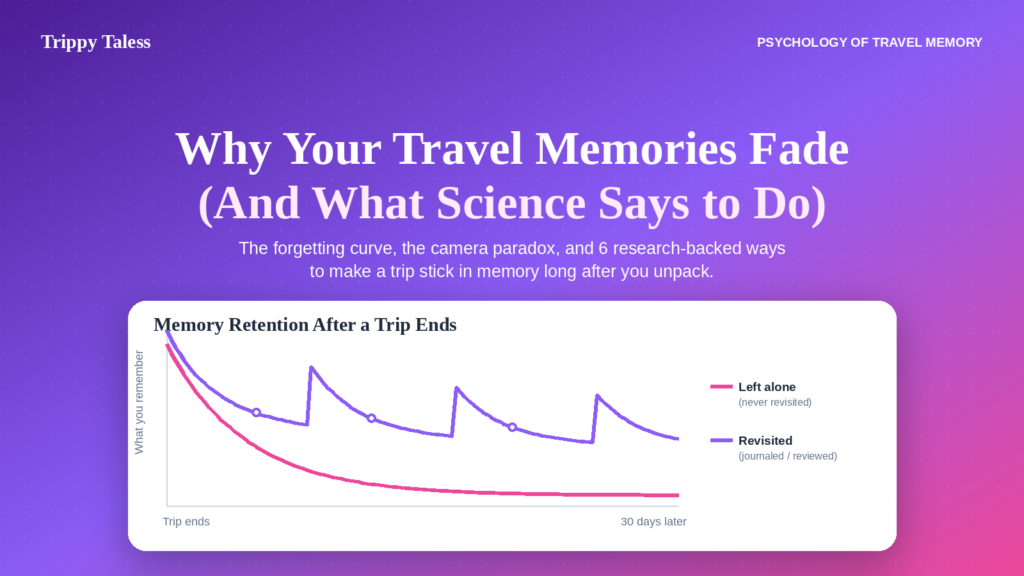
Why Your Travel Memories Fade (And What Science Says to Do)
You’re home. It’s been six weeks. Someone asks about the trip and you reach for the one story that always comes out first — the flight delay, the restaurant, whatever earned “peak moment” status somewhere along the way. Then they ask what you did on the fourth day, and there’s a pause. You know you did something. You have three hundred photos to prove it. But the actual memory — what it felt like to be there, mid-afternoon, before anything remarkable happened — is already gone soft at the edges.
That’s not you being forgetful. That’s why travel memories fade — a specific, well-studied reason memory breaks down faster on a trip than it does at home. Once you understand the mechanism, the fix stops being “try to remember harder” and starts being a couple of small, specific habits — the kind of thing researchers have actually tested, not just travel bloggers.
Quick Answer: Why Do Travel Memories Fade So Fast?
Travel memories fade because the brain never records an experience the way a camera does. It encodes fragments — a smell, a sentence, a color — and those fragments decay fastest in the hours and days right after the event, a pattern known as the forgetting curve. Trips make this worse in three specific ways: they cram unusually large amounts of novel information into a short window, they rarely leave time for the mental “downtime” memory consolidation needs, and modern travel habits (snap a photo, move on) can substitute for actually attending to the moment. None of this is permanent memory loss. It’s memory that was never given the one thing that makes it stick: a second exposure, close to the original event.
The Forgetting Curve: Memory Loss Starts Almost Immediately
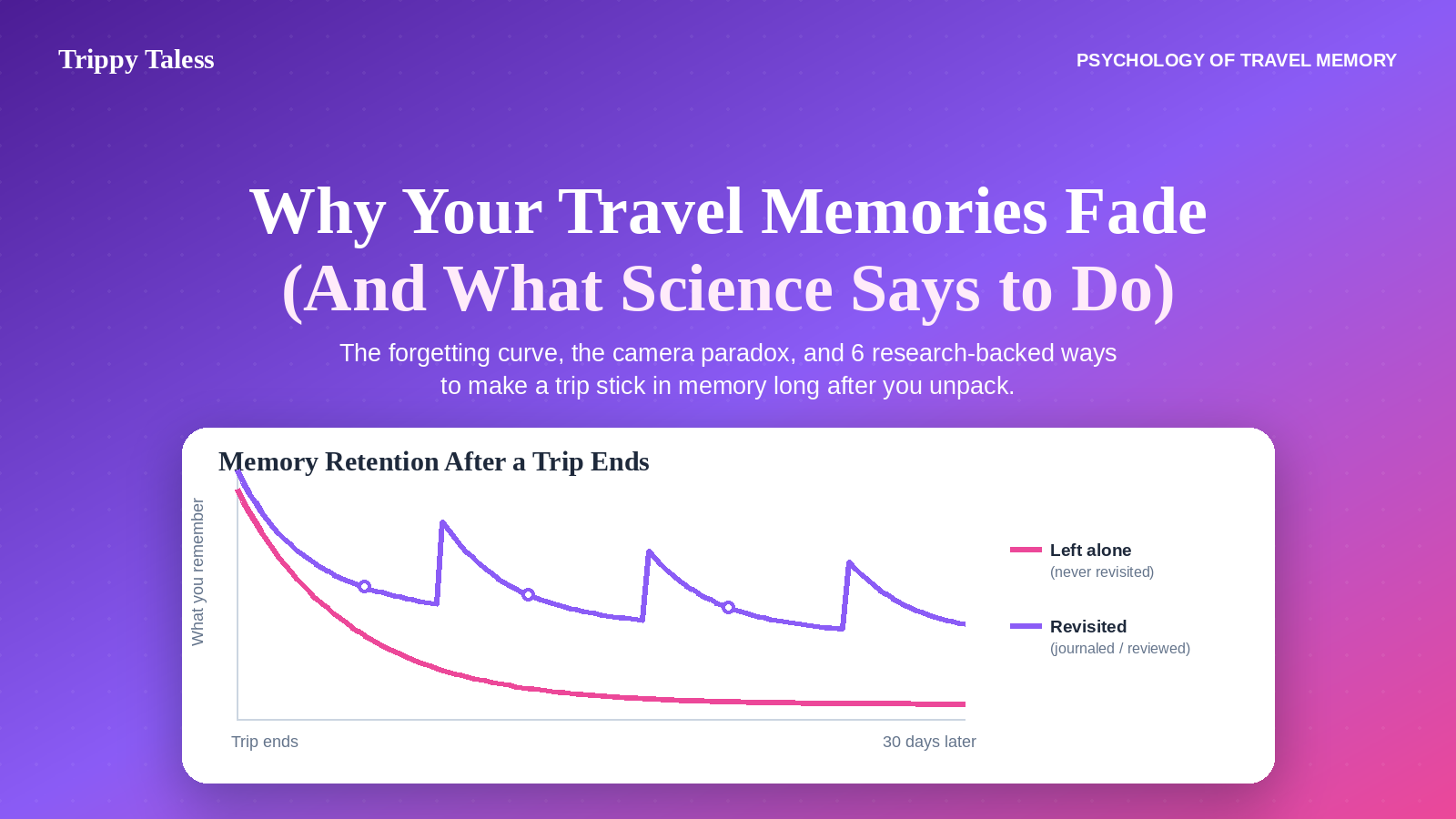
In 1885, a German psychologist named Hermann Ebbinghaus ran an odd experiment on himself. He memorized lists of meaningless syllables — “WID,” “ZOF,” things with no story attached — and then tested how much he could recall after different intervals: 20 minutes, an hour, a day, a week. What he found became one of the most replicated results in psychology: memory doesn’t decay at a steady rate. It falls off a cliff almost immediately, then the rate of loss slows down. Most of what you’re going to forget, you forget within the first day or two. A 2015 replication study published in PLOS ONE ran the same experiment more than a century later and found Ebbinghaus’s curve held up almost exactly.
The practical version of this, as memory researchers put it, is straightforward: without something that reactivates a memory — reviewing it, retelling it, writing about it — the trace weakens fast, and the steepest drop happens in the window right after the experience, not months later. By the time most people sit down to “finally sort through the trip photos,” they’re not organizing a fresh memory. They’re excavating one that already lost most of its detail weeks ago.
This is also why sleep matters more on a trip than people assume. Memory consolidation — the process that moves an experience from a fragile, short-term trace into something durable — happens largely during sleep. Travel is exactly the situation most likely to disrupt it: jet lag, unfamiliar beds, late nights, early flights. You’re asking your brain to do its most important memory-filing work during the exact week it’s least equipped to do it.
Why a 10-Day Trip Feels Like It Should Be More Memorable Than It Is
Here’s the part that trips people up: travel is supposed to be memorable. It’s novel, it’s emotional, it breaks routine — all things that normally help memory. Psychologists even have a name for the pattern where novel, formative experiences dominate what we remember over a lifetime: the reminiscence bump, the well-documented tendency for adults to recall disproportionately more from their teens and twenties than from other decades. Researchers attribute it largely to novelty — that period is packed with firsts, and first-time experiences leave stronger memory traces than routine ones.
So why doesn’t a two-week trip get the same treatment? Because the reminiscence bump describes memories spread across years, each one distinct enough to stand out against a backdrop of routine. A trip compresses that same density of novelty into ten days, with almost no routine in between to create contrast — and no built-in downtime for each day’s experiences to consolidate before the next one starts overwriting it. Day three’s market and day seven’s market start blurring together not because neither mattered, but because your brain never got a quiet moment to file day three away before day four began.
This is the part worth sitting with: the volume of novelty on a trip is a double-edged sword. It’s why travel feels so alive in the moment, and it’s exactly why so much of it turns into a blur in hindsight, unless something forces a second look.
The Camera Paradox: Why Taking More Photos Can Mean Remembering Less
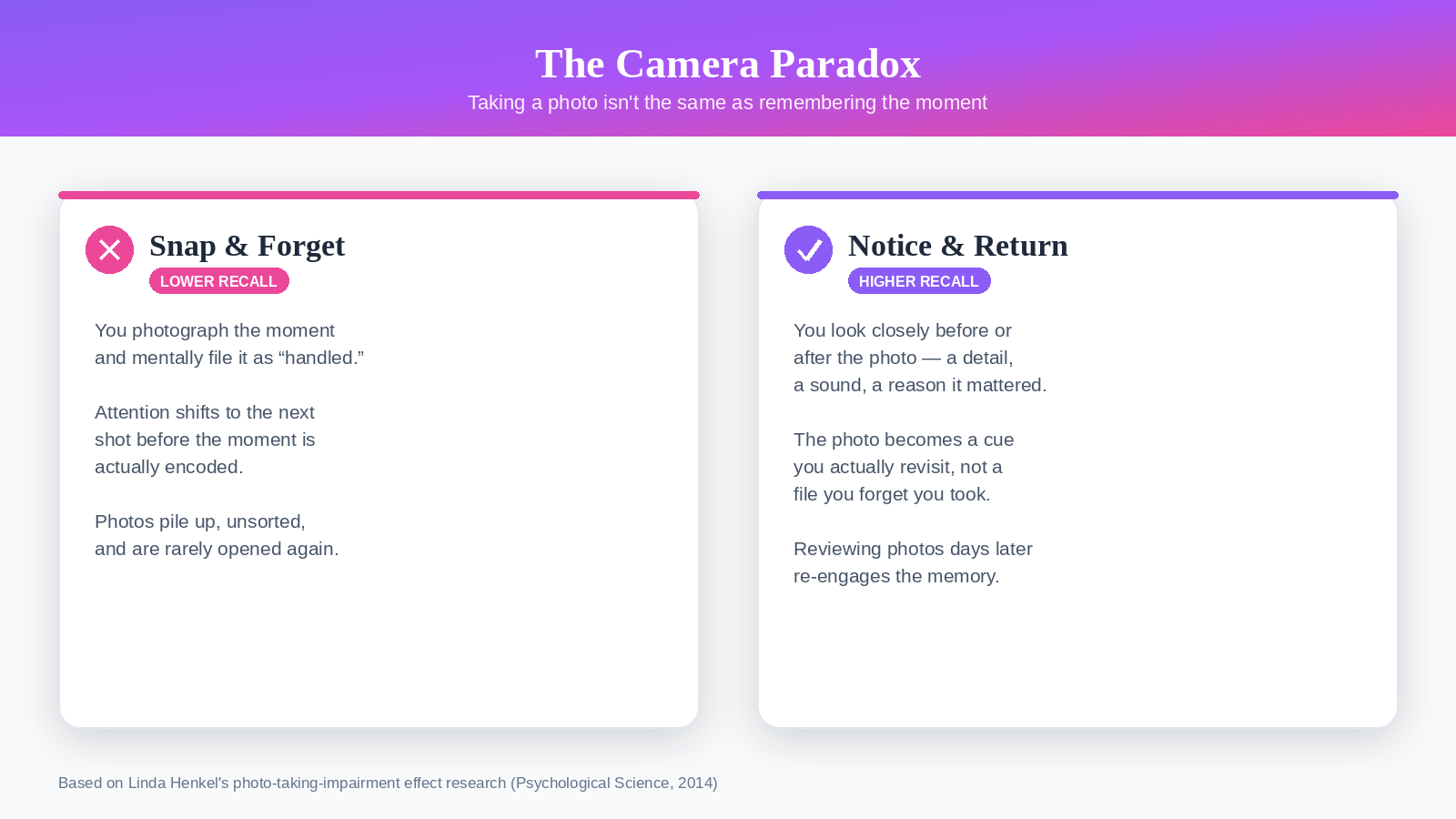
This one tends to surprise people, because it runs against instinct. In 2013, psychologist Linda Henkel led visitors on a guided tour of a university art museum, directing them to photograph some objects and simply observe others. The next day, she tested their memory. The result, published in Psychological Science, was what she now calls the photo-taking-impairment effect: participants remembered fewer of the objects they’d photographed, and fewer details about them, than the ones they had simply looked at.
Her explanation is worth reading in full: “When people rely on technology to remember for them — counting on the camera to record the event and thus not needing to attend to it fully themselves — it can have a negative impact on how well they remember their experiences.” In other words, the camera isn’t neutral. Reaching for it can be a signal to your own attention that this moment has been “handled,” which is exactly the moment your brain checks out and starts looking for the next thing to photograph.
There’s a genuinely useful twist in her follow-up study, though: when people zoomed in on a specific detail before photographing it — actually looking closely enough to frame the shot — the impairment disappeared. Memory for the object, including the parts outside the frame, came back to normal. The problem was never the camera. It was the difference between attending to a moment and merely capturing it.
And Henkel makes a second point that matters even more for anyone with a phone full of unsorted trip photos: “Research has suggested that the sheer volume and lack of organization of digital photos for personal memories discourages many people from accessing and reminiscing about them. In order to remember, we have to access and interact with the photos, rather than just amass them.” Taking the photo was never the finish line. Opening it again is.
Did You Know?
The average smartphone now holds close to 2,800 photos, and more than 1.9 trillion photos are expected to be taken worldwide this year — most of them never printed, captioned, or opened a second time. Travel photos are usually the largest single spike in that pile: a two-week trip can easily produce more images than the rest of someone’s year combined, arriving all at once, with no built-in system for sorting or revisiting any of it.
The Peak-End Rule: You Don’t Remember a Trip Evenly
Even the days you do remember aren’t remembered fairly. Nobel laureate Daniel Kahneman’s research on how people evaluate experiences found something called the peak-end rule: when we recall an extended event, we don’t average out how we felt across the whole thing. We remember the most emotionally intense moment (the peak) and however it ended, and those two data points end up standing in for the entire experience.
This is why a trip with one incredible sunset and a smooth final day can be remembered as “amazing,” even if four of the middle days were logistically frustrating and forgettable — and why a genuinely great trip that ended with a missed flight and an exhausting scramble home can leave a surprisingly sour taste. The middle of the trip, statistically, is doing the least work in your long-term memory of it. Which means if you’re only going to be intentional about capturing part of a trip, the ordinary middle days — the ones without an obvious peak — are the ones that need the help. They’re also usually the ones that get the least effort, because nothing about them screams “remember this.”
The Silver Lining: Bad Moments Fade Faster Than Good Ones
Not all the news here is a problem to solve. Psychologists Richard Walker and John Skowronski have spent years documenting something called the fading affect bias — the finding that the emotional sting of negative memories fades measurably faster than the warmth of positive ones. The lost luggage, the argument about directions, the food poisoning on day six — all real at the time, all disproportionately dulled in a few months, while the good parts stay comparatively vivid.
This is one reason people reliably say they’d “do it again” about trips that were, in the moment, genuinely stressful. It’s not that memory is lying to you. It’s a documented, self-protective bias that quietly edits your personal history toward the positive — which is a good argument for not over-correcting and journaling only the complaints. The annoyances were always going to fade on their own. The ordinary, unremarkable good moments are the ones that need active help, because nothing about them is emotionally sharp enough to earn a place in the peak-end summary.
Nostalgia Isn’t Sentimental Filler — It’s Doing Real Psychological Work
It’s worth addressing the instinct some people have that dwelling on old trips is a little indulgent, a little backward-looking. The research doesn’t support that framing. Social psychologists Constantine Sedikides and Tim Wildschut, who have spent close to two decades studying nostalgia experimentally, describe it as “a psychological resource” that measurably increases meaning in life, self-esteem, and a sense of social connectedness — not a wistful side effect of aging, but an active, usable coping tool people reach for during stress or transition.
For travel specifically, that reframes the whole point of preserving a trip. It’s not about archiving proof that something happened. Revisiting a genuinely good memory — deliberately, not accidentally — is one of the more reliable, low-cost ways psychologists have found to boost mood and sense of continuity in your own life story. Losing access to that memory isn’t just losing a nice photo. It’s losing a tool you could have kept using.
What Actually Works: 6 Ways to Make Travel Memories Last
None of this research points toward “remember better” as a personality trait some people have and others don’t. Understanding why travel memories fade points toward a small number of specific, well-supported habits — none of which require becoming a different kind of traveler.
1. Revisit within days, not months. The forgetting curve’s steepest drop happens almost immediately, so the highest-leverage moment to reinforce a memory is while you’re still on the trip or within the first week home — not “eventually,” which is when most people plan to deal with their photos.
2. Write two or three sentences, not a full journal entry. The research on expressive and reflective writing doesn’t require literary output. A short caption with a specific, sensory detail — what something smelled like, what someone said — does more for retention than a long entry written from a fading memory a month later.
3. Zoom in before you shoot. Henkel’s follow-up study found the photo-taking-impairment effect disappeared when people framed a specific detail instead of snapping the whole scene reflexively. The extra two seconds of attention is the part that actually encodes the memory.
4. Organize photos into a story, not a folder. Henkel’s own conclusion was explicit: unsorted volume is what discourages people from ever reopening their photos. A day-by-day structure you can actually scroll through gets revisited. An undifferentiated camera roll of 2,000 images doesn’t.
5. Tell the story out loud, more than once. Retelling is its own form of rehearsal — every time you describe a moment to someone new, you’re reactivating and re-strengthening that memory trace, which is part of why the stories you tell most end up the sharpest ones years later.
6. Give the unremarkable middle days deliberate attention. Because of the peak-end rule, the ordinary afternoons are the ones most likely to be lost entirely. They’re also, often, the ones people are happiest to rediscover years later — so they’re worth the extra two minutes the “big” moments don’t need.
What Fades Fast vs. What Sticks
| Left to chance | Given a little help |
|---|---|
| Photos dumped in one unsorted camera roll | Photos grouped by day and place, easy to reopen |
| A memory never mentioned again after the trip | A memory retold at least once, out loud or in writing |
| A caption written weeks later from a hazy recollection | A note written the same day, while detail is fresh |
| Every day treated the same (or not treated at all) | Ordinary middle days get the same attention as the “big” ones |
| A photo taken reflexively, already thinking about the next shot | A moment of actually looking before or after the shutter click |
Where an AI Travel Journal Fits Into the Science
Every habit on that list has the same practical obstacle: it takes a little time, and travel is exactly when time and energy are already spoken for. That gap — knowing what helps memory but not having the bandwidth to do it manually — is the actual problem an AI travel journal is supposed to solve. Cloud backup solves storage. It doesn’t solve any of the six habits above.
This is the specific gap Trippy Taless is built around. Instead of a folder of two thousand unsorted photos waiting for a “someday” sorting project, it groups images by day and location automatically, surfaces the shots most worth revisiting, and gives you a structure to add the two or three sentences of real detail that turn a photo into a memory you’ll actually reopen. It’s not a replacement for paying attention on the trip itself — nothing is. It’s the part that happens after the trip, when the forgetting curve is already working against you and the last thing you have energy for is manually rebuilding a day-by-day archive from scratch. If you’re evaluating options, our breakdown of the best travel journal apps in 2026 compares Trippy Taless against the other well-known tools in the category, and our guide to how to organize travel photos covers the manual version of the same process if you’d rather do it by hand.
Frequently Asked Questions
Why do my travel memories fade so quickly? Memory doesn’t record experiences like video — it stores fragments that decay fastest in the days right after the event (the forgetting curve). Trips compress an unusual amount of novelty into a short window with little downtime for consolidation, and that combination means detail is lost faster than it would be from ordinary daily life, unless something reactivates the memory soon after.
Does taking more photos help or hurt my memory of a trip? It depends on how you take them. Reflexively snapping a photo and moving on can reduce what you remember — the “photo-taking-impairment effect.” But photographing something after actually looking closely at it, and later reviewing the photo, supports memory rather than replacing it.
How long after a trip should I write about it to remember it well? As soon as possible, ideally within the first few days while you’re still on the trip or just home. The steepest part of the forgetting curve happens almost immediately, so a short note written the same day preserves far more real detail than a longer entry written weeks later from memory.
Is it normal to only remember a few highlights from a long trip? Yes — this is the peak-end rule at work. People tend to remember an experience’s most intense moment and how it ended, not an average of the whole thing, which is why the “unremarkable” middle days of a trip are usually the first ones to disappear from memory.
Why do I remember the bad parts of a trip less than the good parts, looking back? That’s a documented pattern called the fading affect bias: the emotional sting of negative memories fades faster than the warmth of positive ones. It’s a normal, self-protective feature of memory, not a sign anything is wrong with your recall.
What’s the best way to preserve travel memories long-term? Research points to the same few habits regardless of the tool: revisit the memory soon after the trip (not months later), write a few specific sentences rather than a vague summary, organize photos into something you’ll actually reopen, and retell the story more than once. An AI travel journal app can automate the organizing and drafting side of this, but the timing — doing it soon — matters more than the tool.
Can an app actually help me remember a trip better, or is that just marketing? The mechanism is real, not just a marketing claim: apps that make it easy to revisit and organize photos soon after a trip directly support the two things memory research says matter most — timely reactivation and reduced friction to actually reopening the material. That’s a different function from cloud storage, which keeps photos safe but does nothing to encourage revisiting them.
Key Takeaways
- Memory loss is steepest right after an experience (the forgetting curve), which is why trips feel vivid in the moment and blurry within weeks if nothing reactivates them.
- Travel compresses an unusual amount of novelty into a short window with little time for consolidation — the same density that makes travel feel alive is part of why it’s hard to remember evenly.
- Reflexively photographing a moment without attending to it can measurably reduce recall (the photo-taking-impairment effect) — but engaging with what you’re photographing, and reviewing photos later, reverses that effect.
- The peak-end rule means the “big” moments and the trip’s ending dominate memory by default; the ordinary middle days need deliberate attention or they disappear first.
- Negative memories fade faster than positive ones (the fading affect bias), which is part of why almost every trip gets remembered more fondly with distance.
- Nostalgia isn’t idle sentimentality — research ties it to measurable gains in wellbeing and meaning, which makes preserving memories worth the effort, not just a nice-to-have.
- The single habit tied most consistently to what survives long-term is revisiting the memory soon after the trip, in an organized, low-friction way — which is exactly the gap between owning thousands of photos and actually remembering the trip they came from.

Final Thought
None of this means you’re bad at remembering, or that you should have journaled more diligently on every trip you’ve ever taken. It means memory was never designed to hold onto raw experience by default — it holds onto what gets reactivated, and travel, by its nature, gives you the least time and energy to do that reactivating while it still matters most.
The fix isn’t more discipline. It’s lower friction, applied soon after the trip ends, while the forgetting curve is at its steepest and the memory is still worth saving. That’s the exact gap Trippy Taless is built to close — organizing your photos into a story automatically, so the only thing left for you to do is the two sentences that make it yours. Try Trippy Taless free and give your next trip a better chance of still feeling vivid a year from now.
Loved this story? Trippy Taless turns your own travel photos into a curated album like this — automatically.
Start Your Travel Story Free