AI Travel Journal: How AI Is Transforming Travel Documentation
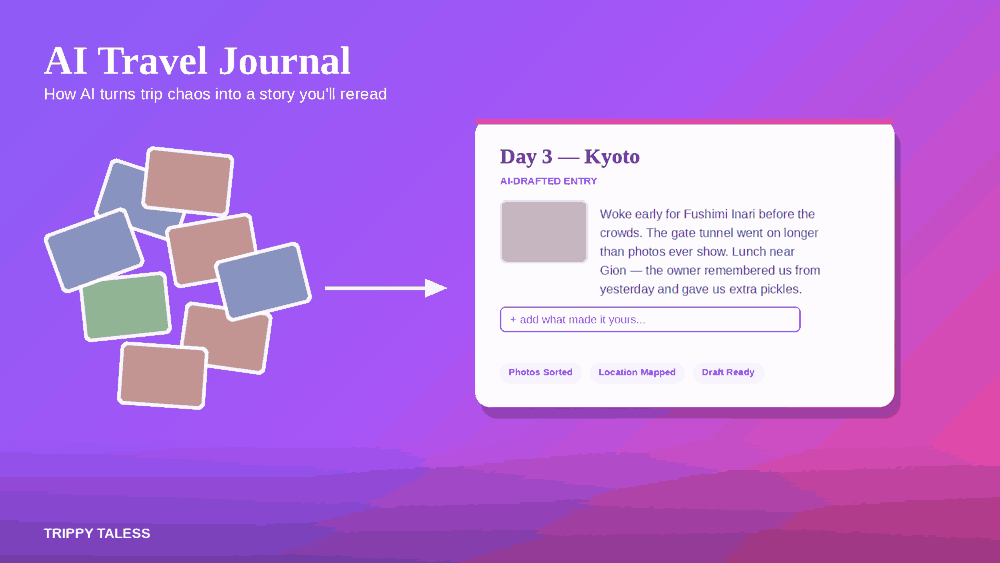
Somewhere around day four of every trip, the same thing happens. You started strong — a few journal entries the first two nights, photos backed up, maybe even a caption or two written while it was all still fresh. Then day four arrives, you’re exhausted, the wifi at the guesthouse is bad, and the journal stays closed. By the time you’re home, you’ve got 900 photos and four days of notes for a twelve-day trip, and the gap between what happened and what you actually wrote down is never going to close on its own.
This isn’t a discipline problem. It’s a design problem. Traditional travel journaling asks you to do your most reflective, detailed writing at the exact moment you have the least time and energy to do it — at the end of a long day of walking, eating, getting lost, and figuring out tomorrow’s transit. Something had to give, and it was almost always the journal.
That’s the gap AI travel journals are built to close, and it’s why they’ve gone from a niche feature to one of the fastest-moving categories in travel tech over the past two years. Not by replacing the instinct to document a trip, but by handling the parts of documentation that were never really about creativity in the first place — sorting, selecting, and getting a first draft on the page.
Quick Answer: What Is an AI Travel Journal?
An AI travel journal is an app that uses artificial intelligence — usually a combination of computer vision and language models — to turn the raw material of a trip (photos, location data, sometimes voice notes) into an organized, readable record with minimal manual effort. Instead of you sorting a camera roll and writing entries from scratch, the AI groups photos by place and day, picks out the shots most likely to matter, and drafts captions or a narrative you edit rather than compose from a blank page.
The practical difference from a normal journal app is effort, not intent. You still end up with a record of your trip. You just don’t have to be the one doing the filing.
Why “Just Write It Down” Stopped Working
Travel journaling has real, well-documented benefits — this isn’t a case that needs to be argued from scratch. Reviews spanning more than 200 studies on reflective writing consistently link the habit to better mood, sharper focus, and stronger recall of the events being written about, and Pennebaker’s foundational research found that writing about meaningful experiences for even 15–30 minutes a few times over a month produced measurable improvements in stress and wellbeing. People who journal about a trip generally remember more of it, and remember it more vividly, than people who don’t.
The problem was never whether journaling works. It’s that almost nobody actually finishes doing it on a trip.
Three things make travel specifically hostile to the habit, compared to, say, journaling at home before bed:
Energy is already spent. A normal day at home has slack in it. A travel day usually doesn’t — you’re on your feet for eight or ten hours, and by the time you’re back at the hotel, willpower is the first thing gone.
The backlog compounds. Miss one night of journaling at home and you write two entries tomorrow. Miss one night on a two-week trip and you’re now trying to remember Tuesday while also living through Wednesday, Thursday, and Friday. The gap doesn’t stay the same size — it grows.
The photos and the words live in different places. You took the photo on your phone. The journal is a separate app, or a paper notebook you didn’t pack, or a notes file you’ll “clean up later.” Reuniting the two after the fact is its own chore, and it’s the chore most people quietly give up on.
None of this is a personal failing. It’s what happens when you design a habit around end-of-day willpower during the part of your life with the least end-of-day willpower available. AI travel journals didn’t succeed by making people more disciplined. They succeeded by removing the parts of the process that discipline was being spent on.
How the Technology Actually Works
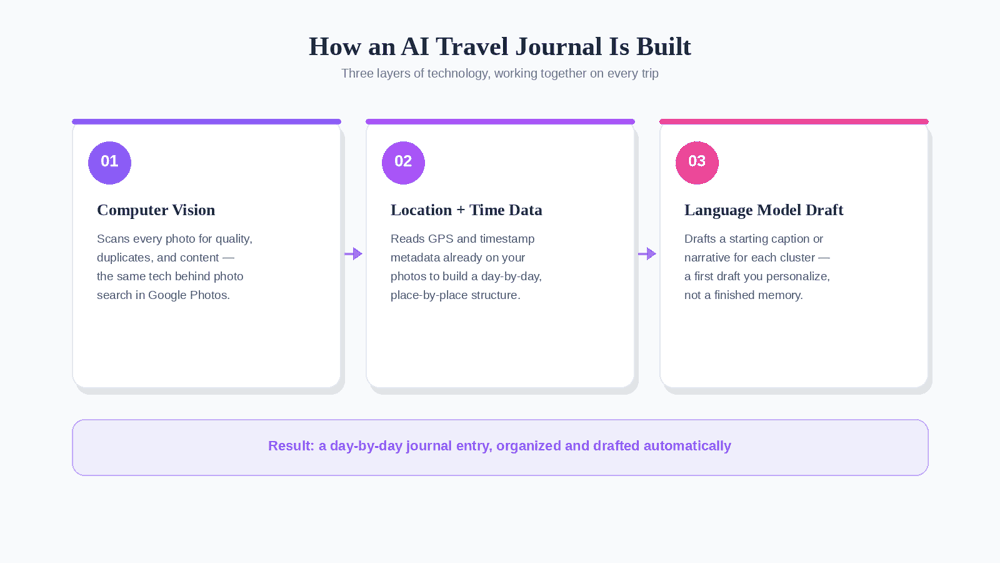
It’s worth understanding what’s actually happening under the hood, because “AI” gets used loosely enough in travel apps that it’s fair to be a little skeptical. There are generally three layers doing the work.
Computer vision handles the photos. This is the same family of technology used in most modern photo apps — object and scene recognition (beach, mountain, street market, plate of food), duplicate and near-duplicate detection (picking the sharpest of eight nearly identical shots), and basic quality filtering (flagging blur, closed eyes, or accidental pocket shots). None of this is unique to travel apps; it’s the same computer vision doing the work in Google Photos and Apple Photos search. What’s different in a travel-specific tool is how the output gets used next — the same culling logic covered in more manual detail in how to organize travel photos is what these models are approximating automatically.
Location and time data provide the structure. Every photo carries EXIF metadata — GPS coordinates and a timestamp — even if you never look at it. AI travel journals use that metadata to cluster photos into days and places automatically, which is exactly the “group by trip and day, not just date” structure that manual organization has to do by hand. This is also how an app can label a cluster of photos “Day 3 — Kyoto” without you typing anything.
Language models handle the writing. This is the newer piece, and the one that’s changed the most in the last two years. Once photos are grouped and the best shots are selected, a language model can draft a caption or a short narrative paragraph describing what the cluster likely represents — a temple visit, a food market, a beach day — based on the location, time of day, and visual content. Critically, in the tools worth using, this is a first draft, not a final answer. You edit it, add the specific detail only you know (the vendor who gave you extra dumplings, the argument about directions that became the trip’s running joke), and the result is faster than writing from nothing but still yours.
It’s worth being honest about the limits here too. Facial recognition and clustering still struggle with low light, crowded group shots, and photos taken years apart as people’s faces change. AI-drafted captions are generic until you personalize them — the model doesn’t know it was raining, or that the ramen shop remembered your order, unless you tell it. The technology removes the blank-page problem. It doesn’t replace the parts of journaling that were the actual point.
Did You Know?
1.95 trillion photos are expected to be taken worldwide in 2026, and the average smartphone now holds close to 2,800 photos — yet more than half of smartphone users say searching their own camera roll for something specific feels overwhelming. The volume problem AI travel journals solve isn’t unique to travel. Travel just makes it happen in a two-week burst instead of spread across a year.
How AI Is Changing Each Stage of Documenting a Trip
Photo Selection Is No Longer a Multi-Hour Chore
The old process: dump a few thousand photos into a folder, then spend an evening (or several) manually deleting duplicates and picking favorites. The AI-assisted version: upload the raw dump, and the app surfaces the shots most likely to be your best — sharp, well-composed, emotionally clear (eyes open, genuine expressions) — while grouping the rest by location and day so nothing gets lost, just deprioritized. This doesn’t eliminate judgment calls. It eliminates the hours of grunt work that used to come before you got to make them.
Organization Happens Automatically, Not as a Separate Project
This is the most mature part of the technology. GPS and timestamp clustering is reliable enough now that most AI travel apps can build an accurate day-by-day, city-by-city structure without any manual tagging — the same structure that used to require you to remember which day you visited which neighborhood and go create folders for it. Apps like Polarsteps built an entire product around passive GPS tracking for exactly this reason: if the app already knows where you were and when, organization stops being work you do and becomes a byproduct of the trip itself.
Writing Gets a First Draft Instead of a Blank Page
This is the newest and fastest-moving layer. Even the journaling establishment has moved here — Day One, one of the longest-running personal journaling apps, added a conversational AI mode and memory-aware prompting in 2026, explicitly because a chat-style “tell me about your day” interface produces more finished entries than a blank text box does. The same logic applies to travel specifically: an AI that already knows you spent the afternoon in Kyoto’s Gion district can draft a starting paragraph, and turning a draft into something personal and specific takes a fraction of the time that starting from nothing does.
Some travelers do this manually today with general tools — feeding ChatGPT a list of the day’s events and asking it to shape them into an entry. It works, but it’s an extra step on top of an already-long day, and it requires you to already have notes to feed it. Purpose-built AI travel journals fold this into the same flow as photo upload, so the draft exists whether or not you had the energy to write anything yourself that night.
Highlight Reels Are the Next Frontier
Photo organization and AI-assisted writing are largely solved problems at this point. The next area of real movement is video — AI that can take a folder of clips and stills from a trip and assemble a short highlight reel automatically, the way editing software has long done for wedding videographers, now made accessible to someone with no editing skill and forty photos from a weekend away. This is still maturing, but it’s the clearest sign of where the category is headed: less manual assembly at every layer of the process, not just the writing.
Manual Travel Journaling vs. AI-Assisted Travel Journaling
| Manual Journal | AI Travel Journal | |
|---|---|---|
| Photo sorting | You cull, delete, and group by hand — often hours per trip | AI groups by location/day and surfaces best shots automatically |
| Writing | Blank page, written from memory, often days after the fact | AI drafts a starting narrative based on photos and location; you personalize it |
| Consistency | Depends entirely on daily willpower — most people miss days | Photos capture the record passively even on days you don’t write anything |
| Time cost per trip | Several hours of sorting plus writing time | Minutes to review and edit AI-generated groupings and drafts |
| Emotional authenticity | Fully yours, but often incomplete | Structure and speed from AI; sentiment and specific memory still come from you |
| Best for | Travelers who genuinely enjoy the act of writing and have the time | Travelers who want the record more than they want the writing process itself |
Neither column is “wrong.” Some people find writing itself meditative and don’t want it automated — a plain notebook is still the right tool for them. AI-assisted journaling exists for the much larger group who want a finished record but, realistically, weren’t going to journal consistently by hand. Given how many travel journals get abandoned after the first week, that’s most people.
Is an AI-Written Journal Still “Real”?
This is worth addressing directly, because it’s the most common objection, and it’s a fair one. If a language model drafts the caption, is the memory actually yours?
The honest answer is that it depends entirely on how the tool is used. There’s a meaningful difference between two workflows that both get labeled “AI journaling”:
Workflow one: AI generates a caption, you accept it unedited, and it becomes your record of the day. This produces a generically accurate but personally hollow document — technically correct, emotionally empty.
Workflow two: AI generates a starting draft based on your actual photos and location, and you edit it — adding the specific joke, the smell of the market, the reason you almost missed the train. This is closer to how a lot of professional writing already works: a first draft that gets shaped into something true by the person who was actually there.
The research on expressive writing backs the second workflow specifically. Klein and Boals’ work on this found that writing about an experience helps free up working memory otherwise occupied by unprocessed thoughts about it — but that effect comes from engaging with and shaping the material, not from a document simply existing. An AI-drafted entry you never touch doesn’t get you that benefit. One you edit, correct, and add real detail to largely does, because you’re still doing the reflective work — just not starting from zero.
The practical guidance: use AI to handle sorting and drafting, and spend the time it saves you on the two or three sentences per entry that only you could write. That’s not a compromise. It’s the same ratio a lot of professional memoirists use — structure and momentum from a process, specificity from memory.
How to Actually Use an AI Travel Journal Well
If you’re trying this on your next trip, a few habits make a real difference in how much you get out of it:
Let it capture passively, but check in every couple of days. The value of AI organization is that it doesn’t require daily discipline — but reviewing what it’s grouped every two or three days, while details are still fresh, means your edits and additions will be sharper than if you wait until you’re home.
Treat AI-drafted captions as a floor, not a ceiling. The draft gets you unstuck. The one sentence you add about who was there or what it actually felt like is the sentence that makes the entry worth rereading in five years.
Don’t let it replace judgment on what mattered. AI is good at “this photo is sharp and well-composed.” It doesn’t know that the blurry, badly-lit photo of your kid asleep on your shoulder on the night train is the one you’ll actually care about later. Rescue those manually — most tools make this a one-tap fix, not a fight against the algorithm.
Do it on the trip, not after. The single biggest factor in whether any journal — AI-assisted or not — ends up meaning something later is how close to the actual moment it was written. This is exactly why apps like Trippy Taless are built around the trip itself: upload photos as you go, let the AI group and draft in the background, and the personalizing takes minutes instead of becoming a project you keep meaning to start once you’re home.
Frequently Asked Questions
Can AI actually create a travel journal from my photos? Yes. Upload your trip photos to an AI travel journal app and it will group them by location and time, select your strongest shots, and draft captions or a short narrative for each day — a real starting structure, not just a sorted folder. You then edit and personalize the draft, which typically takes a fraction of the time full manual journaling would.
Can AI write a travel journal for me, start to finish, with no input? Technically, yes — but you shouldn’t want it to. An unedited AI draft is accurate about what a photo shows and vague about what it meant. The entries that hold up years later are the ones where you added the two or three sentences of real, specific detail the AI has no way of knowing.
Can I just use ChatGPT to organize my travel photos instead of a dedicated app? You can use ChatGPT to help write entries if you feed it notes about your day, but general chat tools can’t read GPS/timestamp metadata to auto-group your photos or select your best shots from a folder of thousands. Purpose-built AI travel journal apps handle that photo-side automation a general chatbot isn’t built to do.
How does AI decide which travel photos are the “best” ones? Most tools score photos on a combination of technical quality (sharpness, exposure, lack of motion blur), composition signals, and content cues like open eyes and clear expressions in people photos, then de-duplicate near-identical shots and surface the strongest of each cluster. It’s a genuinely useful first pass, but it’s optimizing for technical and compositional quality — not sentimental value, which is why a quick manual review still matters.
Is there an AI that can remove blurry photos from my travel camera roll automatically? Yes, this is one of the more reliable AI photo features available today. Motion blur, focus misses, and near-duplicate burst shots are exactly the kind of pattern computer vision models are good at flagging, and most AI travel and photo-organizing apps handle this as a first, largely automatic pass.
Is an AI travel journal worth it if I already back up photos to Google Photos or iCloud? Cloud backup and an AI travel journal solve different problems. Google Photos and iCloud keep your photos safe and searchable; neither turns a photo dump into a day-by-day story. An AI travel journal picks up after backup, organizing by trip narrative and drafting the record you’d otherwise build by hand.
What’s the best AI travel journal app in 2026? It depends on what you’re optimizing for. If passive GPS route-tracking is your priority, Polarsteps is well-established for that specific feature. If AI-assisted writing inside an existing personal journaling habit is what you want, Day One’s newer AI features are built for that. If you want an app built specifically around turning a trip’s raw photos into an organized, AI-drafted story with minimal manual sorting, that’s the exact gap Trippy Taless is designed to fill. For a full side-by-side, see our breakdown of the best travel journal apps in 2026.
Is this different from how couples or families should document trips together? The underlying technology is the same, but shared trips add a wrinkle: photos usually live on two or more phones. If you’re traveling with a partner, see our guide to the best app for couples to document travel together for how AI tools handle merging two camera rolls into one journal.
Key Takeaways
- Traditional travel journaling doesn’t fail from lack of interest — it fails because it asks for reflective writing at the point in the day when people have the least energy for it.
- AI travel journals work by automating the parts of documentation that were never the meaningful part: sorting photos, grouping by location and time, and producing a first draft to edit rather than a blank page to fill.
- The technology combines computer vision (photo quality, duplicates, content recognition), location/timestamp metadata (automatic day-by-day structure), and language models (draft captions and narrative).
- AI-drafted entries are a starting point, not a finished memory — the research on reflective writing’s benefits ties to engaging with and personalizing the material, not to a document simply existing.
- The category is still moving: automated highlight videos are the next major frontier, following photo organization and AI writing, which are largely mature today.

Final Thought
The honest pitch for AI travel journaling isn’t that it makes your memories better. It’s that it makes it far more likely you’ll actually have a record at all — one that doesn’t stall out on day four because you were too tired to write, and doesn’t sit in an unsorted camera roll you never got around to opening. The writing that makes a journal worth rereading was always going to come from you. AI just clears out the hours of sorting and blank-page dread that used to stand between you and getting there.
If you’ve started (and abandoned) a travel journal before, that’s not a personal failing — it’s what the old process was built to produce. Trippy Taless lets the AI handle the sorting and the first draft while you’re still on the trip, so the only part left for you is the part that actually matters: the two sentences only you could write. Try Trippy Taless free and see what your next trip looks like as a finished story instead of an abandoned folder.
Loved this story? Trippy Taless turns your own travel photos into a curated album like this — automatically.
Start Your Travel Story Free