The Science of Travel Nostalgia: Why Best Trips Feel Like Yesterday
You are sitting at your desk on an unremarkable Tuesday. The inbox is overflowing, and the weather outside is an uninspiring shade of grey. Then, without warning, the sharp hiss of an espresso machine or the earthy tang of rain hitting warm pavement catches your senses.
In a fraction of a second, you aren’t at your desk anymore. You are standing on a rain-slicked flagstone alley in Trastevere, laughing under a flimsy umbrella as roasted garlic and diesel drift through the twilight air. You can feel the exact weight of your jacket, the cool mist against your cheeks, and that peculiar, buoyant certainty that the evening held infinite possibilities.
That trip took place four years ago. Yet the memory does not feel four years old. It feels like yesterday. Meanwhile, try recalling what you had for lunch last Wednesday, or what meetings occupied your calendar three weeks ago. Those days are gone—swallowed whole by the brain’s background pruning. Why does an eight-day getaway feel wider, richer, and more immediate in your mind than an entire six-month stretch of your daily routine?
Table of Contents
Quick Answer
Travel nostalgia psychology explains why past vacations feel vivid and emotionally immediate, even years later. When we travel, unfamiliar environments trigger heightened sensory encoding in the hippocampus, while the brain compresses routine time (temporal telescoping). Combined with rosy retrospection—a cognitive bias where the mind filters logistical stress and amplifies meaningful peaks—our memories transform into potent emotional anchors that feel like they happened yesterday. Preserving these moments requires active narrative storytelling rather than passive photo hoarding, a principle that tools like Trippy Taless are specifically built around.
The Architecture of Time: Why Trips Feel Compressed and Eternal
To understand travel nostalgia, we first have to understand how human beings perceive time. Human autobiographical memory does not track days like clocks; it relies on cognitive bookmarks—what psychologists term event boundaries.
During predictable routines, the brain operates in automated prediction mode. Because incoming sensory data matches expectations, the hippocampus does not expend metabolic energy encoding every detail. It simply bundles hundreds of repetitive days into a single cognitive compression file. You experience a month of routine, but your memory stores only a few kilobytes of data.
Travel obliterates automated prediction mode. When you step into an unfamiliar city, every sensory input is novel: foreign speech cadences, new currency, unfamiliar bakeries, and navigation signage. Because your brain cannot predict what happens next, the locus coeruleus floods the hippocampus with norepinephrine, signaling: Pay attention. This is new and relevant.
The Telescopic Effect: Why 2022 Feels Closer Than Last Month
This hyper-encoding creates an asymmetric temporal illusion known in cognitive science as forward telescoping or temporal compression, first analyzed by researchers Norman Bradburn, Lance Rips, and Steven Shevell in 1987. When an autobiographical memory is unusually vivid and emotionally salient, our brains perceive the elapsed time between that event and the present as dramatically shorter than it is.
Because you effortlessly recall the taste of vinho verde in Porto or temple bells in Chiang Mai, your cognitive retrieval assumes the event happened recently. The sheer density of information acts as an anchor pulling the past forward. Neurologically, your trip from three summers ago has far more structural presence in your mind than last autumn.
Rosy Retrospection: How Your Brain Curates Your Journeys
There is an amusing paradox at the heart of vacation memory: real-time experience rarely matches nostalgic recall. In 1997, researchers Terence R. Mitchell and Leigh Thompson published a seminal study in the Journal of Experimental Social Psychology titled “Temporal Adjustments in the Evaluation of Events: The ‘Rosy View'”. Tracking vacationers across three phases, they found:
- The Anticipation Phase: Prior to departure, travelers imagined pure bliss and effortless adventure.
- The Actual Experience: During the vacation, travelers reported substantial fatigue, flight delays, cramped transit, and interpersonal friction—up to 40% of real-time entries contained complaints.
- The Retrospective Phase: Weeks and months later, the exact same travelers looked back with glowing affection. Bad weather became “an atmospheric adventure,” and getting lost became “our favorite funny story.”
This is rosy retrospection. From an evolutionary perspective, human memory is not a surveillance camera; it is a psychological mechanism designed to extract meaning, foster social bonding, and encourage exploration. Rosy retrospection strips away trivial friction and elevates the emotional triumph of discovery.
The Peak-End Rule: Why You Remember Moments, Not Minutes
When reflecting on a trip, our minds do not average all hours spent. Instead, memory adheres strictly to the Peak-End Rule, formulated by Nobel laureate Daniel Kahneman and Barbara Fredrickson in 1993. Retrospective evaluations hinge almost exclusively on two anchors:
- The Peak: The single most intense emotional high point (or low point) of the event.
- The End: How the journey concluded.
Due to duration neglect, whether your trip lasted 5 or 15 days matters remarkably little. What matters are the peaks: mist clearing at the summit, an unexpected dinner with welcoming strangers, or splashing into the sea at golden hour. If your final evening involved a peaceful harbor dinner, your brain catalogs the entire journey as deeply satisfying.
The Psychology of Travel Nostalgia: An Emotional Immune System
Groundbreaking research led by Dr. Constantine Sedikides and Dr. Tim Wildschut at the University of Southampton has established that nostalgia serves as an essential psychological immune system:
- The Existential Buffer: When daily life feels monotonous, travel memories serve as tangible proof that our lives contain richness and autonomy, buffering against anxiety.
- Social Connectedness: Nostalgic reflection significantly increases perceived social connectedness and decreases loneliness. When couples reminisce about a shared trip, relationship satisfaction measurably spikes (see our guide on the best app for couples to document travel).
- Resilience & Optimism: Remembering you navigated a foreign transit system or hiked a steep ridge activates an emotional reservoir of competence, fostering forward-looking optimism.
The Camera Roll Trap: How Phones Sabotage Vacation Recall
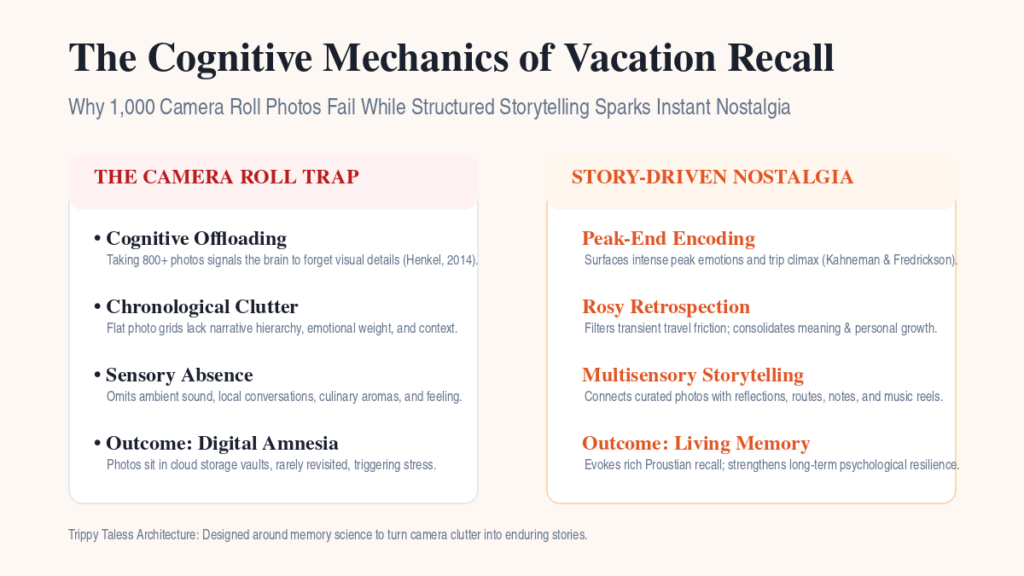
Modern travelers take more photos than any generation before, yet remember their journeys worse. On a typical trip, we capture 600 to 1,500 photos that end up buried in cloud storage under grocery lists and receipts. Cognitive scientists call this the Photo-Taking Impairment Effect.
In a 2014 study in Psychological Science, Dr. Linda Henkel showed that photographing objects during a tour caused participants to remember significantly fewer visual details compared to observing them. We engage in cognitive offloading—outsourcing memory to the smartphone. Scrolling through 800 uncurated thumbnails triggers cognitive fatigue rather than nostalgia. If you’ve ever returned wondering what to do with 800 photos after your trip, you know this feeling.
The 4-Step Framework to Anchor Travel Memories
To keep travel memories vivid and evoke genuine nostalgia for decades, work with your brain’s cognitive mechanics:
- Mindful Capture (The “Zoom-In” Rule): Henkel found that zooming in on a distinctive detail eliminates memory impairment. Take one establishing shot, then two intentional close-ups of sensory details: a chipped sign or ancient woodwork.
- The 48-Hour Narrative Consolidation Window: Within 48 hours of returning, record what cameras miss: inside jokes, scents, and funny mishaps (learn more in why your travel memories fade).
- Ruthless Curation (Peak-End Alignment): A curated collection of 40 meaningful photos triggers far more nostalgia than 1,000 unedited shots. Cull duplicates and keep only peak moments.
- Build a Narrative Arc, Not a Flat Album: Memory is hardwired for story: departure, discovery, challenge, peak, and return. Organizing media by route, timeline, and reflection creates a true portal back in time.
Trippy Taless: Memory Science Meets Effortless Storytelling
This is why Trippy Taless was built. While conventional cloud storage treats travel photos as static files, Trippy Taless applies cognitive psychology to solve photo overwhelm automatically:
- Intelligent AI Curation: Scans camera rolls, filters duplicate bursts, and highlights true emotional peaks.
- Interactive Timeline Storytelling: Maps routes and arranges media into chronological journey chapters.
- Cinematic Highlight Reels: Stitches video clips and stills into evocative highlight reels set to music.
- Collaborative Travel Stories: Unifies camera rolls from partners and family into a single shared album.
Comparison: Camera Storage vs. Science-Backed Storytelling
| Feature | Standard Camera Roll | Paper Scrapbook | Trippy Taless |
|---|---|---|---|
| Approach | Passive storage | Manual craft | Active narrative curation |
| Time Needed | Hours of scrolling later | 15–30 hours of pasting | 5–10 minutes automated |
| Photo Overload | Exacerbates clutter | Limited page space | Culls duplicates, highlights peaks |
| Multisensory | Visual only | Visual and tactile | Visuals, notes, maps & reels |
| Accessibility | Buried under screenshots | Single fragile copy | Secure, cloud-accessible anywhere |
FAQ
Why do travel memories feel like they happened yesterday?
Novel environments trigger dense hippocampal encoding. This cognitive salience creates forward telescoping, making vivid events feel far more recent than routine memories of the same calendar age.
What is the “rosy retrospection” bias in travel?
It is the tendency to remember vacations as more positive than real-time experience. Research by Mitchell and Thompson shows memory naturally filters minor travel irritations, solidifying the highlights into cherished stories.
Does taking too many photos on vacation hurt your memory?
Yes. Dr. Linda Henkel’s work shows excessive photography causes cognitive offloading, leading to reduced recall of visual details. Intentional photography paired with narrative reflection builds much stronger memory.
What is the best app to preserve travel memories?
While cloud drives offer passive storage, Trippy Taless is dedicated to memory preservation—using AI to cull clutter, build timeline stories, and produce cinematic video keepsakes.
Key Points Summary
- Novelty Anchors Memory: Unfamiliar environments stimulate vivid encoding, creating timeless mental landmarks.
- Memory Curates for Meaning: Rosy retrospection and the Peak-End Rule soften travel stress and preserve highlights.
- Avoid the Digital Graveyard: Unsorted photo rolls cause digital fatigue. Stories outlast raw pixels.
- Make Moments Enduring: Use narrative curation to turn scattered photos into living travel memories you can revisit anytime.

Conclusion: Keep the Feeling Alive
One day, flight numbers and train ticket prices will fade. What remains is the feeling—the quiet thrill of an unfamiliar sunrise, salt on your skin after an afternoon by the sea, and the laughter of getting delightfully lost with someone you love.
Those moments deserve better than being buried under screenshots. Take your photos out of the digital dark and turn your journey into an enduring story.
Relive Your Best Journey — Start Your Free Story on Trippy Taless Today →
Loved this story? Trippy Taless turns your own travel photos into a curated album like this — automatically.
Start Your Travel Story Free