Is Polarsteps Still Worth Using in 2026? An Honest Look at the Numbers
Is Polarsteps worth it in 2026? It has spent the better part of a decade as the default answer to “what app do you use to track your travels?” It’s the one your backpacker friend showed you on a hostel Wi-Fi connection in 2019, the one with the little dotted line crawling across a map, the one that turns into a genuinely nice hardcover book when you get home.
Two things happened to it in 2026 that make “is Polarsteps still worth it” a different question than it was even twelve months ago. In July, the company introduced Polarsteps Plus, its first real paid subscription tier, ending years of being entirely free. And in early September, an investigation by the Dutch outlet Follow the Money found that Polarsteps’ own systems had been leaking user location data, photos, and home addresses to anyone who knew where to look — including, in a genuinely alarming twist, the movements of active-duty soldiers from several countries.
Neither of those things automatically means you should delete the app. But they’re exactly the kind of developments that change whether a five-year-old recommendation still holds up. This isn’t another “best Polarsteps alternatives” roundup — we already wrote that one, and you can find it here if you want a full lineup of competing apps. This is a straight verdict: what Polarsteps actually does well in 2026, what changed, what it still gets wrong, and who it’s genuinely worth using for.
Quick Answer
Yes, with caveats. Polarsteps’ core experience — automatic GPS trip tracking, a shareable map, offline recording, and printed Travel Books — remains free and is still one of the most complete tools of its kind, according to both our research and its 4.8-out-of-5 rating from nearly 3,800 Trustpilot reviews as of September 2026. Polarsteps Plus (€8.99/month or €29.99/year) adds 3D maps, trip statistics, and more collaborator slots, but skip it unless you specifically want those extras — the core app isn’t gated behind it. The bigger factor for 2026 is a September data exposure that let outsiders pull location and photo data from millions of trips, including ones set to private; Polarsteps says it has since tightened its systems, but it’s worth knowing about before you decide how much of your trip to make public. If what you actually want is a curated, story-shaped record of a trip rather than a route map, that’s a different job — one Trippy Taless is built around specifically.
Table of Contents
What Polarsteps Actually Does
If you’ve never used it, Polarsteps is best understood as a travel tracker first and a journal second. Open the app when you leave home, and it uses your phone’s GPS to quietly log your route in the background — where you slept, where you stopped, how far you moved between “steps” — building an interactive world map as you go. You can drop in photos, short notes, and flight or transport details at each stop, and the whole thing syncs to a shareable trip page that friends and family can follow without needing an account.
It works offline, too: the app caches your location and any photos or notes you add while you’re off the grid, then uploads everything once you’re back on Wi-Fi or data. That’s a genuinely useful property for the kind of trip — rural hiking, long train rides through patchy-signal regions — where you’d otherwise lose the record entirely.
Since our last look at Polarsteps, the company has also added an AI Trip Planner, which builds a personalized itinerary based on your travel style and past trips (if you opt in), lets you edit stops and transport choices, and explains why each suggestion was made. It’s a planning feature, not a memory-keeping one, but it’s worth knowing it exists if you last used Polarsteps purely as a route tracker.
What’s Still Free in 2026
Here’s the headline that matters most for anyone worried the app has gone paywall-first: it hasn’t. Polarsteps states directly in its help center that trip planning, tracking, sharing, and following other travelers are “all completely free,” and that remains true after the July 2026 launch of Plus. The free tier includes:
- Automatic GPS route tracking, including offline recording
- Unlimited trips, photos, and notes
- A shareable trip page and the ability to follow up to 5 Travel Buddies per trip
- The AI Trip Planner and drag-and-drop itinerary builder
- Trip privacy controls (public, followers-only, or private)
- The option to order a printed Travel Book (an add-on purchase, not a subscription)
Polarsteps makes its money from Travel Book sales, the optional Plus subscription, and small commissions on hotel or activity bookings made through the app — not from ads or, in its own words, from selling your data. That business model is genuinely more transparent than a lot of “free” travel apps, which is part of why the September privacy story (more on that below) landed as such a contradiction to the brand’s own pitch.
Polarsteps Plus: What You Get for €8.99/Month
Polarsteps Plus launched in July 2026 as the company’s first subscription tier. According to Polarsteps’ official pricing page, it costs €8.99 per month or €29.99 per year (about 72% cheaper than paying monthly), with prices that may vary slightly by region and currency. Here’s what it actually unlocks, confirmed against Polarsteps’ own support documentation as of September 2026:
| Feature | Free | Polarsteps Plus |
|---|---|---|
| Plan, track, share, and relive trips | ✅ | ✅ |
| Travel Buddies per trip | Up to 5 | Up to 10 |
| 3D map view of your route | ❌ | ✅ |
| Additional map styles (Winter, Terrain) | ❌ | ✅ |
| Step stats & elevation profile | ❌ | ✅ |
| “Play mode” (animated route replay) | ❌ | ✅ |
| Discount on Travel Books | — | 20% (annual plan only) |
| Plus profile badge | ❌ | ✅ |
Notice what’s not on the Plus side of that table: the map itself, offline tracking, sharing, the AI Trip Planner, and Travel Book ordering all stay free. Plus is additive — extra ways to look at data you’re already generating — rather than a toll gate on features that used to be free.
Is Polarsteps Plus Worth It?
Polarsteps’ own support article on this — refreshingly candid for a company page — puts it plainly: Plus “is about getting more from your journeys. It’s not about unlocking the basics.” Their guidance, and ours, lands in a similar place:
Plus is a reasonable buy if you:
- Genuinely enjoy the “relive” side of a trip — 3D terrain maps and animated route replay are the kind of extras that reward slow, nostalgic scrolling
- Hike, bike, or do multi-transport overland trips where elevation and distance-by-mode stats mean something
- Travel in a group of 6+ and need more than 5 shared contributors on one trip
- Order Travel Books regularly enough that the annual plan’s 20% discount offsets a meaningful chunk of the €29.99 cost
Skip it if you:
- Mostly use Polarsteps to plan trips before you leave — planning tools are entirely free
- Take short city breaks where elevation charts and 3D terrain add little
- Mainly use the app to follow friends and family rather than log your own trips
For most casual users, the free tier is still the complete product. That’s a genuinely rare thing to be able to say about a five-year-old app that just added its first subscription — and it’s worth crediting Polarsteps for not gutting the free experience to push the new tier, something plenty of “freemium” apps do quietly over time.
The Story That Changes the Calculation: September 2026’s Data Exposure
This is the part of the “is Polarsteps worth it” question that didn’t exist the last time most review articles about the app were written.
On September 7–8, 2026, Cybernews and the Belgian outlet ITdaily both reported on an investigation by the Dutch outlet Follow the Money, which found that Polarsteps’ backend API had insufficient access controls — no per-trip authorization checks and no meaningful rate limiting. The practical result: researchers were able to pull user names, roughly 230 million photos and videos, and about 1 billion GPS location points from nearly 2 million trips, simply by querying the API directly. Some of that data belonged to trips the owners had explicitly marked private or followers-only.
A second, more specific problem compounded it. Polarsteps had been storing and exposing the location metadata embedded in uploaded photos — meaning a picture taken of packed suitcases at home, before a trip even started, could reveal a user’s exact home address to within a few meters. Follow the Money‘s follow-up reporting used this to track military personnel from the Netherlands, Belgium, the UK, the US, and France between their home bases and deployment locations, including NATO facilities. The Dutch Ministry of Defence has since banned Polarsteps from service phones, and Belgium’s Defence Ministry confirmed that apps sharing location data are already barred near military installations.
Polarsteps’ response, in its own statement, disputes that this counts as a “breach” in the technical sense — no passwords were compromised, and no one bypassed authentication to get into a private account. That’s a fair technical distinction, but it doesn’t really answer the more basic question of whether users’ data was adequately protected, which is what most travelers actually care about. To its credit, the company says it has since:
- Tightened API rate limiting and restricted which data fields the API returns
- Stopped sharing photo location metadata by default
- Strengthened protections around “secret link” trip sharing
- Notified the Dutch Data Protection Authority
What this means for you in practice: if you use Polarsteps, it’s worth reviewing your trip privacy settings now rather than assuming “private” has always meant private, and worth being more deliberate about which photos (especially ones taken at home) you attach to a public or followers-only trip going forward. This is a live, developing story as of publication — treat the specifics above as accurate to September 2026, and check current reporting if you’re reading this later.
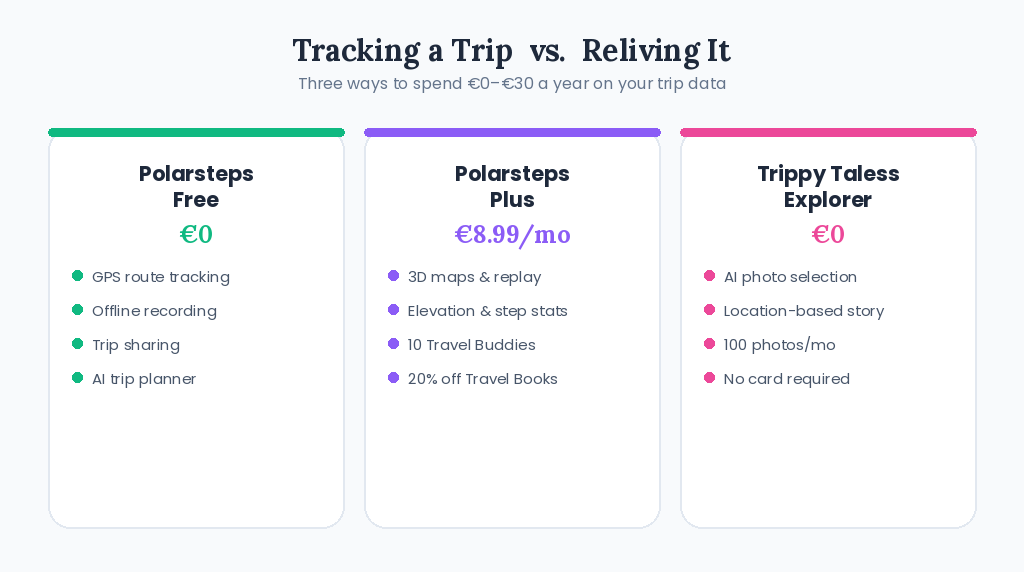
At a glance — tracking a trip vs. reliving it: Polarsteps Free covers GPS route tracking, offline recording, trip sharing, and the AI trip planner at €0. Polarsteps Plus (€8.99/mo) adds 3D maps, elevation and step stats, 10 Travel Buddies, and 20% off Travel Books. Trippy Taless Explorer (€0) covers AI photo selection, a location-based story, and 100 photos/month with no card required. Polarsteps tracks where you went; Trippy Taless organizes what you kept — they solve different halves of the same trip.
The Limitations That Were Already There
Setting the privacy story aside, Polarsteps has a handful of structural limits that predate 2026 and haven’t changed with Plus or the AI Trip Planner:
It maps a route — it doesn’t shape a story. Polarsteps is built around chronological “steps” pinned to GPS coordinates. That’s excellent for answering “where did I go and when,” but it does very little to help you turn hundreds of trip photos into a curated, readable narrative. You still have to choose which photos matter, write your own captions, and manually build anything resembling a finished keepsake beyond the automatic map.
You can’t merge trips. If you accidentally split a single journey into two logged trips, or want to combine years of visits to the same country into one continuous record, Polarsteps doesn’t currently support that natively — a limitation several long-time users have raised in reviews.
Privacy settings are broad, not granular. You can set a trip to public, followers-only, or private, but there’s no way to give, say, close family more visibility than casual followers on the same trip. Combined with September’s exposure story, this is worth understanding before you assume “followers-only” fully protects sensitive details.
Desktop use is view-and-plan only. You can browse trips, build itineraries, and upload photos from a browser, but there’s no way to actually track a route from a laptop — GPS logging only happens through the mobile app.
Occasional GPS quirks. Long-time users, including a seven-year reviewer at Matt’s Next Steps whose review was last updated in August 2026, note occasional distance or location inaccuracies, more commonly reported on Android than iOS — generally attributed to phone GPS hardware rather than the app itself.
None of these are dealbreakers on their own. But they matter for the “worth it” question specifically because they define what Polarsteps is for: documenting where you went, not curating what it meant.
Comparison: Free vs. Plus vs. Trippy Taless
| Polarsteps Free | Polarsteps Plus | Trippy Taless (Explorer, free) | |
|---|---|---|---|
| Core job | GPS route tracking & sharing | Route tracking + extras | AI-curated photo story from your trip |
| Price | Free | €8.99/mo or €29.99/yr | Free (100 photos/mo) |
| GPS auto-tracking | ✅ | ✅ | ❌ (not its purpose) |
| AI photo selection | ❌ | ❌ | ✅ |
| 3D maps / route replay | ❌ | ✅ | ❌ |
| Printed keepsake | Travel Book (paid add-on) | Travel Book (20% off, annual) | Not yet available |
| Best for | Logging & sharing a live trip | Hikers, overlanders, groups | Turning photos into a finished story afterward |
These two apps aren’t really competing for the same five minutes of your attention. Polarsteps wants to be open during your trip, tracking your movement in the background. Trippy Taless is built for the moment you get home with 600 unsorted photos and no idea where to start — it runs AI analysis to surface your best shots and organizes them into a location-based album automatically, which is a different problem than route-mapping entirely. If you want a longer look at how that AI curation works, we’ve covered it in more depth in AI Travel Journal: How AI Is Transforming Travel Documentation.
Who Polarsteps Is Still Worth It For
- Long-distance hikers, cyclists, and overlanders who genuinely want elevation data, transport-mode breakdowns, and a 3D replay of a route — this is where Plus earns its price
- Solo travelers who want family to worry less — the live, shareable trip page is a low-effort way to keep people updated without a group chat
- Anyone who wants a printed keepsake built directly from a GPS-logged route, especially group trips with contributions from multiple people
- Travelers in patchy-signal regions who need reliable offline location logging
Who Should Look Elsewhere (or Pair It With Something Else)
- If you want a finished story, not a map — Polarsteps gives you the raw material (dots, photos, notes) but leaves the curation and structure to you. That’s the exact gap AI-curated tools are designed to close.
- If privacy is your top priority — September’s exposure story is a legitimate reason to think twice about how much of a trip you make visible, or to lean toward apps that don’t require continuous location tracking at all.
- If you come home with hundreds of unsorted photos and dread going through them — that’s a photo-curation problem, not a tracking problem, and it’s worth pairing Polarsteps’ route data with a tool built specifically to sort and story-fy the photos afterward.
For that second use case specifically, a growing number of travelers now use both: Polarsteps to track the route in real time, and a curation tool like Trippy Taless afterward to turn the resulting photo pile into something they’ll actually revisit. The two aren’t mutually exclusive — they solve different halves of the same trip.
FAQ
Is Polarsteps still worth using in 2026?
Yes, for its core purpose — automatic GPS trip tracking, sharing, and Travel Books remain free and well-reviewed (4.8/5 on Trustpilot from 3,786 reviews as of September 2026). The main new factor to weigh is September 2026’s data exposure story, which is worth understanding before deciding how much of a trip to share publicly.
Is Polarsteps free?
Yes. Planning, tracking, sharing, and following trips are all free and, per Polarsteps’ own statements, will stay that way. The company monetizes through optional Travel Book purchases, the Polarsteps Plus subscription, and small affiliate commissions on bookings — not ads or data sales.
Is Polarsteps Plus worth it?
For most casual travelers, no — the free tier already includes everything needed to plan, track, and share a trip. Plus (€8.99/month or €29.99/year) is worth it mainly for hikers, overlanders, and larger groups who want 3D maps, elevation stats, route replay, or more than 5 collaborators per trip.
How much does Polarsteps cost?
The core app is free. Polarsteps Plus costs €8.99/month or €29.99/year (roughly 72% cheaper annually), and Travel Books are priced individually based on page count and binding, typically starting somewhere in the €30–€40 range according to third-party reviews, since Polarsteps doesn’t publish a single fixed starting price.
Is Polarsteps safe to use after the September 2026 data exposure?
Polarsteps says it has tightened API access controls, stopped sharing photo location metadata by default, and strengthened its secret-link sharing feature since the exposure was reported. It’s reasonable to keep using the app while being more deliberate about trip privacy settings and which photos you attach to public or followers-only trips.
What’s the difference between Polarsteps and Trippy Taless?
Polarsteps is a GPS-based trip tracker — it logs your route automatically while you travel. Trippy Taless is an AI photo-curation tool built for after the trip: you upload your photos, and AI selects your best shots and organizes them into a location-based story. They solve different problems and can reasonably be used together.
Does Polarsteps work offline?
Yes. It records your GPS location and any photos or notes you add without a connection, then syncs everything once you’re back on Wi-Fi or mobile data.
Can Polarsteps turn my photos into a travel story, not just a map?
Not automatically. You can attach photos and notes to each tracked step, but organizing them into a readable narrative is manual work. Tools built specifically for AI photo curation, like Trippy Taless, are designed to do that sorting and structuring step for you.
Key Points Summary
- Polarsteps’ core experience — GPS tracking, sharing, offline recording, Travel Books — remains genuinely free in 2026, and that hasn’t changed with the launch of Plus
- Polarsteps Plus (€8.99/mo or €29.99/yr, launched July 2026) adds 3D maps, elevation stats, route replay, and more Travel Buddies — worth it mainly for hikers, overlanders, and larger groups
- A September 2026 data exposure, reported by Cybernews and ITdaily based on a Follow the Money investigation, found that Polarsteps’ API let outsiders access photos, GPS data, and home addresses from millions of trips, including some marked private — Polarsteps has since tightened access controls
- Structural limitations predate 2026: no trip merging, broad (not granular) privacy tiers, and no way to auto-generate a curated story from your photos, just the map
- Polarsteps tracks where you went; it isn’t built to organize or story-fy what you photographed once you got there — that’s a separate job
- Pricing, features, and the exposure response above are accurate as of September 2026 and worth rechecking if you’re reading this later in a fast-moving product category
Compare Trippy Taless

Polarsteps is still a solid choice for tracking where you went. But if you’re the kind of traveler who comes home with 500 photos scattered across your camera roll and no real plan for turning them into something worth revisiting, that’s a different problem — and it’s the one Trippy Taless is built to solve.
Upload your photos, and AI selects your best shots and organizes them into a location-based travel story automatically, no manual sorting required. The Explorer plan is free, handles up to 100 photos a month, and doesn’t ask for a card to get started.
Last updated: September 2026
Loved this story? Trippy Taless turns your own travel photos into a curated album like this — automatically.
Start Your Travel Story Free