How to Preserve Travel Memories: 15 Best Methods That Actually Work
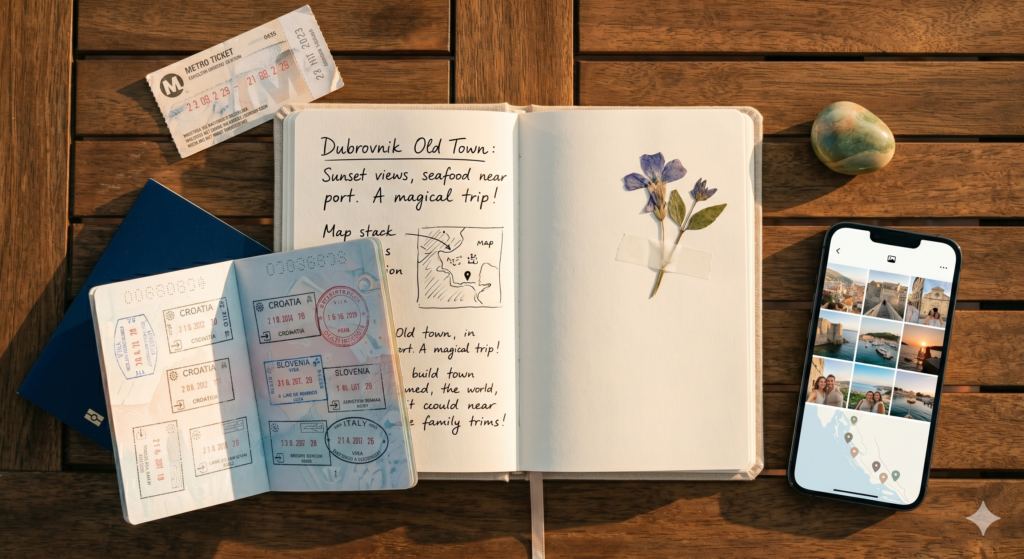
Table of Contents

Why Your Travel Memories Are Disappearing Right Now
You spent two weeks in Japan. You ate ramen at a tiny counter restaurant in a Kyoto side street that had no English menu and the best broth you’ve ever tasted. You watched the sun come up over Fushimi Inari before the crowds arrived. You got lost in Osaka’s Dotonbori and ended up finding something better.
You took 847 photos.
Six months later, you’ll struggle to remember the name of that ramen place. The details of the sunrise will compress into a single image. The magic of getting lost will blur with every other trip you’ve taken.
This isn’t a memory problem unique to you — it’s biology.
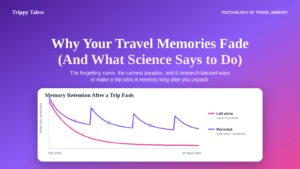
In 1885, German psychologist Hermann Ebbinghaus discovered what he called the forgetting curve: the rate at which memories decay after an experience. His research revealed that within the first hour after an event, we lose roughly 50% of newly formed details. Within a week, up to 90% of unanchored memories are gone. Within a month, even vivid experiences can compress into fragments.
Travel memories are particularly vulnerable. They happen in rapid succession over a short window of time. They’re full of novelty, which means the brain doesn’t automatically prioritize them the way it does routine events. And once you’re home, the familiar environment gives your brain exactly zero cues to reinforce what happened abroad.
The cruel irony: the more extraordinary the trip, the faster the details fade — because there’s simply too much richness for the brain to encode completely.
But here’s the empowering flip side: preservation is a choice, not an accident. The travelers who hold onto their experiences most vividly aren’t necessarily the ones who took the most photos — they’re the ones who deliberately created anchors for their memories.
This guide gives you 15 of the best, most practical methods to do exactly that.
The 48-Hour Window: Why Timing Is Everything
Before we get into the methods, there’s one principle you need to internalize: the 48 hours after an experience are the most powerful preservation window you have.
Memory researchers call this consolidation — the process by which short-term memories transfer into long-term storage. During this window, the emotional and sensory details are still vivid. The brain is still replaying the experience. This is when adding any kind of anchor — a journal entry, a voice memo, a photo caption, even a conversation — dramatically increases how much you’ll retain for years.
After 48 hours, memories start their long, quiet compression.
Most people wait until they’re home, exhausted, back at work, and catching up on email before they try to document a trip. By then, the ramen place in Kyoto has already started to fade.
The methods below are organized so the time-sensitive ones come first. You don’t need to do all 15. But if you do nothing else, do the first three within 48 hours of each significant day of travel — and watch how much more of your trip you carry with you a year from now.
15 Best Methods to Preserve Travel Memories
Method 1: Capture Stories, Not Just Shots
The average smartphone user takes 4,900 photos per year. Most are never viewed again after upload.
The problem isn’t the quantity of photos — it’s the absence of story. A photo of a sunset is beautiful. A photo of the sunset you watched from a rooftop in Santorini with the person you love, right after you got engaged, is a memory.
Context is what transforms a photo into a story. And context is almost always left out of the photo itself.
The shift: When you’re taking photos, take a “context shot” first — a wide frame that shows where you are, what’s happening around you, and who you’re with. Then take the detail shot. This habit takes ten extra seconds per scene and multiplies the storytelling power of your entire camera roll.
Bonus: fewer photos, better stories. You’ll come home with 300 intentional images instead of 800 reflexive ones.
Method 2: Write Your Travel Story Within 48 Hours
You don’t need to be a writer. You don’t need a beautifully bound leather journal. You need five minutes and a willingness to jot down the emotional highlights of your day.
This is the single most effective memory preservation method there is. Writing activates memory consolidation — the physical act of putting an experience into words forces the brain to encode it more deeply.
What to write:
- The one moment today that made you feel most alive
- Something unexpected that happened
- A sensory detail you want to remember (a smell, a taste, a sound)
- What you were thinking or feeling at the time
It doesn’t need to be poetic. “The market at 7am — nobody else there, smell of fresh bread, old woman selling tomatoes, felt like I belonged” is worth more than any perfectly composed photo.
Pro tip: If writing isn’t your thing, skip ahead to Method 3 — voice memos do the same job, faster.
Method 3: Voice Memo Your Days (The Underrated Hack)
Open your phone’s voice memo app. Hit record. Talk for three minutes.
Seriously — that’s the entire method.
Voice memos are the most underused travel memory tool in existence. They’re faster than writing, more personal than a photo, and they capture tone, emotion, and spontaneity in a way that typed words rarely do.
Try recording a “day close” memo each evening before bed, covering:
- Where you went
- What you ate
- The moment that stood out most
- How you felt
When you listen back six months later, you won’t just remember the trip — you’ll be back in it. Your past voice has an intimacy and a specificity that no photo can replicate.
Many travelers who discover this method say it becomes the most valuable archive they have.
Method 4: Let AI Curate Your Best Moments
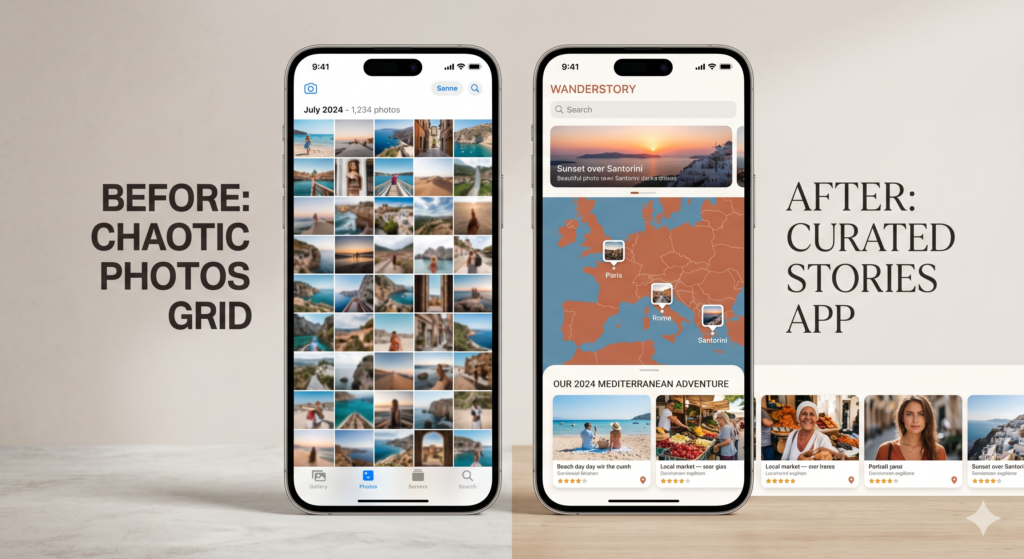
You came home with 847 photos. You know there are 150 great ones in there. But sorting through the rest — the blurry shots, the duplicates, the seventeen near-identical pictures of the same temple — is a task that never gets done.
So the 150 great ones stay buried in a camera roll you never open.
This is exactly the problem AI-powered travel apps like Trippy Taless were built for. Instead of spending hours selecting photos manually, the app’s AI automatically identifies your best shots — filtering out duplicates, blurry images, and near-identical frames — and turns them into a beautiful, organized travel story.
The difference this makes is psychological as much as practical. When your photos are curated into a coherent story rather than a raw dump of 847 images, you actually revisit them. You share them. You relive the trip. And that act of revisiting is itself the most powerful memory reinforcement tool you have.
Preservation isn’t just capture — it’s curation.
Method 5: Build a Location-Anchored Timeline
The human memory is spatial. We remember where things happened, and locations work as powerful retrieval cues.
One of the most effective ways to organize travel memories isn’t chronologically — it’s geographically. When your photos, notes, and memories are anchored to the places where they occurred, you can “walk back through” the trip spatially and unlock memories you didn’t even know you still had.
Apps like Trippy Taless organize your stories by location automatically, mapping photos and notes to the specific place they were taken. Looking at a pin on a map triggers a completely different kind of recall than scrolling a timeline.
If you’re doing this manually: create a folder for each city or location, drop the relevant photos and notes inside, and add a cover image. Even this simple structure is dramatically more effective for memory access than a flat camera roll.
Method 6: Create a Travel Album That Tells a Story
A photo album is different from a folder of photos. An album has a beginning, middle, and end. It has a point of view. It’s a narrative object — something you can flip through and share, something that communicates the experience to someone who wasn’t there.
The difference between a camera roll and an album is curation and sequence. When photos are ordered to tell a story — starting with arrival, moving through the experience, ending with departure — they stop being a documentary record and start being a memory artifact.
Trippy Taless makes this automatic: upload your photos, and the app assembles them into a sequential, location-tagged travel story with clean layout and visual hierarchy. No design skills needed.
The result is something you’ll actually want to open again — and something worth sharing with family, friends, and anyone asking “how was the trip?”
Method 7: Collect the Physical Scraps
A metro ticket from Paris. The paper menu from the restaurant with no English name. A dried flower from the market in Marrakech. A small stone from the beach.
These tactile objects carry enormous mnemonic power. The science of embodied cognition suggests that physical objects act as external memory nodes — touching them activates sensory memory pathways that photos and words can’t reach.
The travelers with the richest long-term travel memories often have a small archive of physical mementos — not expensive souvenirs, but the everyday scraps of a trip that would seem meaningless to anyone else and are irreplaceable to them.
The habit: Each day of travel, set aside one small physical item. At the end of the trip, store them together in an envelope or small box labeled with the destination and date.
Pair them with a voice memo or journal entry, and you’ve created a multi-sensory memory anchor that will outlast any digital album.
Method 8: Map Your Journey Visually
There’s something deeply satisfying about seeing your journey drawn out on a map — the arc of cities visited, the distances traveled, the geographic context that you lose when you’re in the middle of it.
A journey map does three things:
- It gives you a bird’s-eye view of the narrative arc of the trip
- It serves as a visual cue that triggers associated memories by location
- It’s a shareable artifact that communicates the scale and shape of your travel story
You can do this digitally (Google My Maps, Trippy Taless’s built-in map feature) or physically (a printed map with marked pins). Either way, spending 15 minutes placing your stops on a map after a trip is an excellent memory anchor.
Method 9: Cook a Dish from the Trip
Taste and smell are the most powerful memory triggers of all five senses — they connect directly to the limbic system, the brain’s emotional and memory center, bypassing the rational cortex entirely.
When you smell the same spice or taste the same dish you had on a trip, you don’t just remember the experience — you feel it again, with an immediacy that no photo or journal entry can replicate.
Find a recipe for one dish you loved. Cook it once a year. The ritual becomes a tradition, and the tradition becomes a living memory.
Method 10: Record Short “Day in the Life” Videos
A photo shows a moment. A video shows time — the movement, the sounds, the ambient life of a place.
You don’t need to edit or produce anything. A 60-second clip filmed with your phone — the street outside your window in the morning, the food market, the sunset — captures audio and motion that transforms a static image into a living memory.
The minimal habit: record one 60-second clip per day, intentionally. Just one. At the end of a 10-day trip, you’ll have a 10-clip mini-documentary of your journey that takes seconds to create and is completely irreplaceable.
Method 11: Return to Your Memories on a Schedule
Psychologists call this spaced repetition — the practice of revisiting information at increasing intervals to dramatically improve long-term retention. It’s the mechanism behind virtually every effective learning system, and it applies equally well to travel memories.
The act of revisiting a travel story — looking through the album, reading the journal entry, listening to a voice memo — reinforces the neural pathways of that memory and slows the forgetting curve.
The practice: Set a recurring reminder on your phone for 1 week, 1 month, 3 months, and 1 year after any significant trip. Each time it fires, spend five minutes looking through your photos or reading a journal entry. That’s it.
The difference in long-term retention is dramatic. These four brief sessions can be the difference between a trip you remember vividly for a decade and one that’s fully compressed within a year.
Apps like Trippy Taless can surface “this time last year” memories automatically — the digital equivalent of finding an old diary entry.
Method 12: Share Your Story in a Format Worth Sharing
Memory is social. We remember experiences more vividly when we share and retell them — because each retelling is itself a form of spaced repetition.
But most travel “sharing” is either a 30-second Instagram story or an exhausting data dump of photos sent to a family group chat.
The middle ground — a beautiful, organized travel story that communicates the highlights and the feeling of the trip without requiring the viewer to sort through 847 photos — is both more memorable for the sharer and more compelling for the audience.
Trippy Taless makes it possible to share a clean, visual travel story with a single link, complete with location timeline, curated photos, and personal notes. The kind of thing someone actually clicks through and reads.
Method 13: Print a Physical Photo Book
There’s something about a physical photo book that digital albums can’t replicate: it has weight. You can hold it. You can hand it to someone. It sits on a shelf and asks to be opened.
Digital files feel permanent but are brittle — they live on platforms that change, apps that shut down, hard drives that fail. A printed book is a physical artifact.
Services like Artifact Uprising, Chatbooks, and Printique make it easy to turn a curated photo selection into a professional-quality book. The key word is curated — not 847 photos, but 60–80 of the best ones, in narrative order.
Pair this with the AI curation from Method 4, and the process takes an afternoon, not a week.
Method 14: Document the People, Not Just the Places
Ask yourself: when you look back at a trip five years from now, what will matter most?
Probably not the famous landmark. Probably not the “iconic” shot everyone takes from the same spot. Probably the moment you had a real conversation with a stranger in a bar in Budapest. The afternoon you spent with your partner just walking with no destination. The face of your child the first time they saw the ocean.
The people in your photos — and the relationships — are the emotional core of any travel memory. And they’re systematically underrepresented in most travel photography, which focuses on places, food, and landscapes.
The challenge: on your next trip, take at least one genuine portrait of each person you’re traveling with, in a moment that captures who they are — not a posed shot in front of a landmark.
These are the photos that will wreck you (beautifully) in 20 years.
Method 15: Build a Multi-Year Travel Archive
A single trip is a memory. A decade of trips is a story about who you are.
The travelers with the richest relationship to their past adventures are the ones who maintain a consistent archive across years — a growing record of where they’ve been, who they were when they went, and how each trip changed them.
This doesn’t require elaborate organization. It requires a single consistent system: one place where every trip lives, with its photos, notes, and moments, organized chronologically and geographically.
Trippy Taless is designed to be this place — a long-term travel archive that grows with you, surfaces memories at the right moments, and turns years of travel into a visual life story rather than disconnected folders in a camera roll.
The Best Apps to Preserve Travel Memories in 2026
Not all travel apps serve the same purpose. Here’s a quick breakdown of the best options depending on your needs:
| App | Best For | Key Feature | Price |
|---|---|---|---|
| Trippy Taless | All-in-one travel storytelling | AI photo selection + travel albums + location timeline | Free tier available |
| Polarsteps | GPS route tracking | Real-time trip tracking on a map | Free / Premium |
| Day One | Long-form journaling | Beautiful diary with deep writing features | $2.99/month |
| Journi | Quick photo organization | Auto-timeline by location | Free / Premium |
| Google Photos | Backup & basic organization | Cloud storage, basic AI features | Free (15GB) |
What makes Trippy Taless different: most travel apps either focus on route tracking (Polarsteps), text journaling (Day One), or cloud backup (Google Photos). Trippy Taless focuses specifically on travel storytelling — using AI to curate photos and organize them into a beautiful, shareable story. It’s built for the user who wants to actually relive their trips, not just store them.
FAQ: How to Preserve Travel Memories
What is the best way to preserve travel memories? The most effective combination is: (1) write or voice-memo your experiences within 48 hours while they’re still fresh, (2) use an AI-powered tool like Trippy Taless to curate and organize your photos into a story, and (3) revisit those memories at 1 week, 1 month, and 1 year intervals. The key is creating multiple anchors — written, visual, and physical — rather than relying on photos alone.
Why do travel memories fade so quickly? The brain’s forgetting curve means that roughly 50% of new memories fade within the first hour, and up to 90% are gone within a month if not reinforced. Travel memories are especially vulnerable because they happen rapidly in a novel environment, and once you return home, your familiar surroundings provide no cues to reinforce what happened abroad. The solution is active reinforcement — journaling, organizing photos, and deliberately revisiting your memories.
How do I organize hundreds of travel photos without spending hours on it? The fastest approach is to use an AI-powered app like Trippy Taless, which automatically identifies your best shots, removes duplicates and blurry images, and organizes them into a location-based travel story. Manually, the most efficient system is to sort photos into city/location folders immediately after each day of travel — before they pile up at trip’s end.
What is the best app to preserve travel memories? Trippy Taless is built specifically for travel memory preservation — combining AI photo curation, location-based organization, travel albums, and easy sharing in one app. For GPS route tracking, Polarsteps is excellent. For detailed text journaling, Day One is the gold standard. For basic cloud backup, Google Photos covers the essentials.
How soon after a trip should I organize my photos? Within 48 hours is ideal — this is the window when your emotional memory is still vivid and you can add context to photos that would otherwise be meaningless six months later. At minimum, organize photos before returning to work and the routine that will make it feel impossible.
Can AI really preserve travel memories better than traditional methods? AI doesn’t replace the human act of reflection and storytelling — but it dramatically lowers the friction of getting there. The biggest reason people don’t preserve their travel memories isn’t lack of desire; it’s the overwhelming volume of photos and the time required to process them. AI tools like Trippy Taless remove that friction, making it possible to go from 800 unorganized photos to a beautiful travel story in minutes.
How do you make travel memories last longer? The science of spaced repetition offers the clearest answer: revisit your memories at increasing intervals — 1 week, 1 month, 3 months, 1 year after a trip. Each revisit slows the forgetting curve. Pairing revisits with multi-sensory cues — cooking a dish from the trip, looking at a physical memento — makes them even more powerful.
What should I write in a travel journal to preserve memories? Focus on emotional highlights rather than itinerary. Write: (1) the moment that made you feel most alive today, (2) something unexpected or surprising, (3) a sensory detail — taste, smell, sound — you want to hold onto, (4) what you were thinking or feeling. This approach takes 5–10 minutes per day and produces memories you’ll treasure for decades.
Key Takeaways
- Travel memories fade fast — up to 90% of details can disappear within a month due to the forgetting curve
- The 48-hour window after any experience is your most powerful preservation window; act within it
- Photos alone aren’t enough — memories need anchors: stories, voice memos, and organized albums
- AI tools like Trippy Taless dramatically reduce the friction of photo organization and story-building
- Revisiting memories on a schedule (spaced repetition) is the single most effective long-term retention strategy
- The most powerful memories are rarely the famous landmark — they’re the people, the conversations, the unexpected moments
- A consistent, multi-year travel archive transforms individual trips into a coherent life story
Start Your Travel Story Today
You’ve just gotten back from a trip — or you’re already planning the next one.
The photos are on your phone. The memories are vivid right now. But without a plan, most of what made that trip extraordinary will compress into fragments within weeks.
Trippy Taless makes it easy to turn your travel photos into a beautiful, organized story — automatically. The AI selects your best moments, organizes them by location, and creates a travel album you’ll actually want to revisit. And share.
It takes less time than you think. Your memories are worth it.
→ Start Your Free Travel Story on Trippy Taless
Have a method that works brilliantly for you? Share it in the comments — the best travel memory tip might come from a fellow traveler.
Loved this story? Trippy Taless turns your own travel photos into a curated album like this — automatically.
Start Your Travel Story Free